


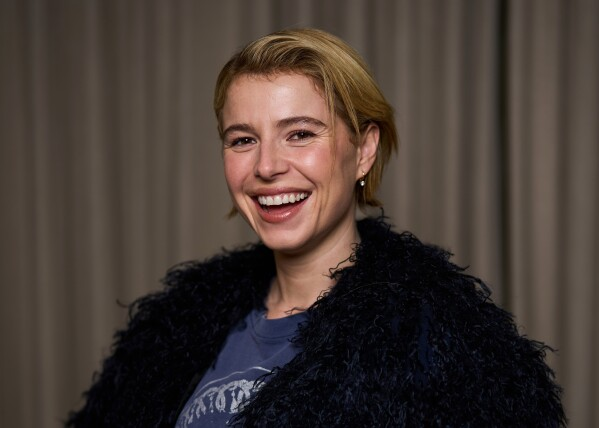
Maggie Gyllenhaal: From Acclaimed Actress to Defining Voice Behind the Camera
A Career Rewritten in Real Time
For decades, Maggie Gyllenhaal built a reputation as one of Hollywood’s most emotionally fearless performers. Her work in films like Secretary, The Dark Knight, and Crazy Heart established her as a distinctive presence—an actor capable of navigating complex, often uncomfortable roles with precision and depth.
- A Career Rewritten in Real Time
- The Turning Point: When Acting Was No Longer Enough
- “The Lost Daughter”: Proof of Concept
- Scaling Up: “The Bride” and Expanding Ambition
- A Personal Story That Humanizes the Shift
- The Vermont Contrast: Two Worlds, One Balance
- Industry Implications: What Her Shift Represents
- The Future: Is Acting Completely Behind Her?
- Conclusion: A Career Realigned Around Control and Expression
Yet in 2026, the conversation around Gyllenhaal has shifted decisively. She is no longer simply an actress with an impressive résumé. She is now emerging as a filmmaker with a clear artistic identity—and, by her own admission, someone who has found a more authentic professional home behind the camera.
“I don’t know. I really prefer directing. This is a better job for me.”
That statement, delivered in recent interviews, signals more than a preference. It reflects a structural shift in her career—one grounded in creative control, authorship, and long-term artistic direction.
The Turning Point: When Acting Was No Longer Enough
Gyllenhaal’s transition did not occur abruptly. It was the result of accumulated tension between artistic ambition and the limitations of acting roles.
Her experience on the HBO series The Deuce proved pivotal. Playing a character striving for creative agency, she encountered firsthand the constraints of being solely a performer within a larger system. That experience reframed her understanding of authorship in storytelling.

As she later explained:
“I felt as an actress, to be honest, like I always would hit up against a wall of how much I was able to participate or express. And when I moved into writing and directing, I didn’t have to play that game anymore.”
The distinction is structural. Acting is inherently collaborative, often shaped by external direction, production decisions, and script constraints. Directing, by contrast, centralizes vision and execution—allowing for a more complete articulation of ideas.
“The Lost Daughter”: Proof of Concept
Gyllenhaal’s directorial debut, The Lost Daughter (2021), was not a tentative experiment—it was a decisive statement.
The film earned three Academy Award nominations, including recognition for her adapted screenplay. Performances by Jessie Buckley and Olivia Colman were also nominated, reinforcing the film’s critical standing.
More importantly, the project validated her transition. It demonstrated that her instincts as a storyteller extended beyond performance into narrative construction, tone, and thematic exploration.
Critics described the film as “a strikingly assured debut,” a characterization that positioned Gyllenhaal not as a novice director, but as a filmmaker with immediate credibility.
Scaling Up: “The Bride” and Expanding Ambition
Her second feature, The Bride (2026), marks a clear escalation in scope.
Featuring Jessie Buckley in multiple roles and Christian Bale as the creature, the film represents a move into larger-scale production while maintaining a distinct artistic voice. It also signals industry confidence—studios are willing to invest in her vision at a higher level.
This transition—from intimate psychological drama to a more expansive cinematic project—illustrates a broader trajectory: Gyllenhaal is not experimenting with directing; she is building a sustained directing career.
A Personal Story That Humanizes the Shift
Amid the professional evolution, Gyllenhaal’s public appearances continue to reveal a more informal, personal dimension—often through anecdotes that contrast sharply with her precise creative work.
In a recent podcast appearance, she recounted an incident involving her husband, actor Peter Sarsgaard, and his beekeeping hobby. Left in charge of his hives while he traveled for work, Gyllenhaal admitted responsibility for an unexpected outcome.
“All of his bees in Brooklyn died because he made a mistake, he made a beekeeping mistake and he was so upset about it.
“I was like Peter you were in Switzerland acting and then you went and did another movie in London right away and you were home for one week and your bees died. Some people’s only job is doing bees. Give yourself a break .”
Pressed further on her role, she conceded:
“Yeah maybe I did.”
The anecdote, while light in tone, reveals the duality of her current life: a filmmaker navigating large-scale productions, while also managing the practical—and sometimes chaotic—details of domestic life.
The Vermont Contrast: Two Worlds, One Balance
That duality is further illustrated by the couple’s lifestyle split between Brooklyn and a remote property in Vermont.
Gyllenhaal describes the Vermont home as “Way deep, deep inside the … national forest,” emphasizing that it reflects her husband’s preferences more than her own. The setting is defined by manual labor and self-sufficiency—stacking wood, raising chickens, tapping maple trees, and maintaining bee colonies.
“He like raises bees and chickens and taps maple trees and has a lovely garden … ”
Her perspective on the environment is pragmatic:
“If I knew it was only for a week, I could do a week.”
This contrast—urban creative production versus rural isolation—mirrors her broader career transition. One space is controlled, authored, and deliberate; the other is unpredictable and grounded in routine.
Industry Implications: What Her Shift Represents
Gyllenhaal’s move from acting to directing is not an isolated case. It reflects a broader structural trend within the film industry:
- Actors seeking authorship: Increasingly, established performers are transitioning into directing to gain creative control.
- Narrative ownership: Writing and directing allow for more consistent thematic exploration across projects.
- Changing career longevity models: Directing offers a longer-term pathway compared to acting roles, which are often age-dependent.
However, what distinguishes Gyllenhaal is the clarity of her commitment. Her statements suggest this is not a dual-track career—it is a redefinition.
The Future: Is Acting Completely Behind Her?
The question remains open, but current signals point in one direction.
While some industry observers speculate about selective returns to acting, her own words indicate otherwise. Directing is not a secondary pursuit—it is, in her view, “the better job.”
Her trajectory suggests continued expansion:
- Larger productions with broader distribution
- Deeper collaboration with recurring actors
- Increasing influence within studio systems
At this stage, a return to acting appears less like a plan and more like a remote possibility.
Conclusion: A Career Realigned Around Control and Expression
Maggie Gyllenhaal’s evolution is not simply a shift in job title. It is a recalibration of how she engages with storytelling.
After nearly three decades in front of the camera, she has repositioned herself at the center of the creative process—where decisions originate rather than respond.
Her journey illustrates a broader principle within the creative industries: control over narrative often defines the next phase of a career.
In Gyllenhaal’s case, that phase is already underway—and it is increasingly difficult to separate her identity from the films she now directs.