





A Final Curtain Call: Inside Bruno Salomone’s Funeral and the Quiet Legacy He Leaves Behind
A Farewell Marked by Dignity and Emotion
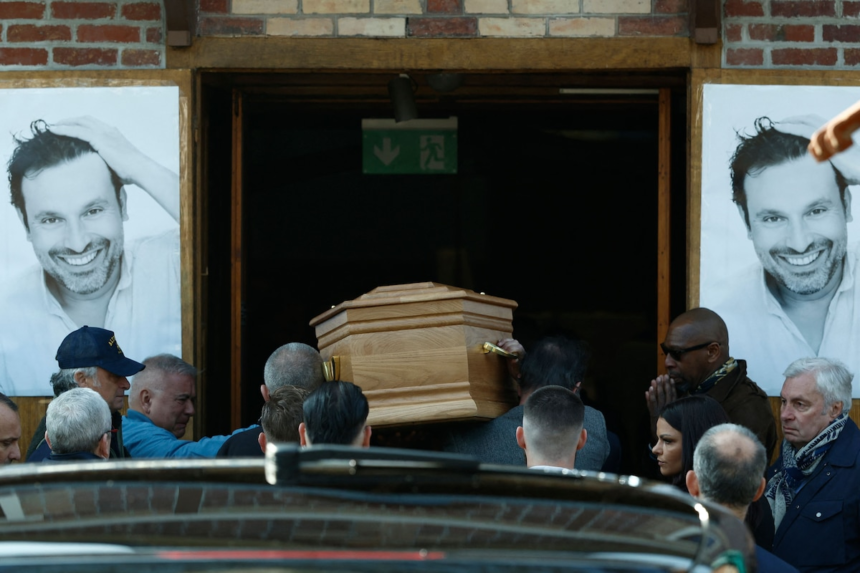
On Monday, March 23, a quiet suburb east of Paris became the focal point of collective grief and remembrance. At the Sainte-Anne church in Polangis, located in Joinville-le-Pont, family, friends, and admirers gathered for the funeral of Bruno Salomone—an actor whose understated brilliance left a lasting impression on French television and comedy.
The ceremony, open to the public, reflected the personality of the man it honored: discreet, sincere, and deeply human. Salomone, who passed away on March 15 at the age of 55 after a long and private battle with illness, was remembered not only for his talent but for the quiet strength he carried through his final days.
At the center of this farewell stood his wife, Audrey. Present until her husband’s last breath, she arrived at the church visibly overwhelmed. Despite dark glasses and a composed exterior, emotion quickly surfaced. Upon arrival, she burst into tears—a moment that captured the profound personal loss behind the public tribute.
The Presence of a Community: Friends, Colleagues, and Companions
The funeral drew a wide circle of mourners, many of whom had worked alongside Salomone over decades. Among them was Jean Dujardin, a close friend whose presence carried symbolic weight. Their friendship, spanning nearly 30 years, represented one of the most enduring bonds in French entertainment.



Dujardin, visibly affected, attended quietly, entering from the back of the church. Later, he would take on a deeply personal role—helping carry the coffin, a gesture that underscored both friendship and respect.
Several members of the iconic troupe “Nous Ç nous” were also present, as were colleagues from the beloved series Fais pas ci, fais pas ça. Actress Isabelle Gélinas, who played his on-screen wife, appeared particularly moved. Valérie Bonneton, another co-star from the series, joined the gathering, alongside figures such as Davy Sardou, Vincent Desagnat, Laurent Mariotte, and Jean-Luc Reichmann.


The turnout was not simply a reflection of celebrity networks—it was evidence of a professional community bound by genuine affection for a man described repeatedly as kind, attentive, and quietly generous.
A Life Lived with Discretion—and Courage
Salomone’s death followed what those close to him described as a “long and discreet battle with illness.” He had chosen to keep his condition largely private, resisting the visibility often associated with public figures facing serious health challenges.
This discretion extended even to his closest collaborators. Actress Hélène de Fougerolles recalled learning of his illness only in fragments:
“You know, I had cancer,” he once confided casually, years earlier. The recurrence, revealed later, remained equally shielded from public view.
In his final months, Salomone received palliative care in hospital. Despite the physical toll, those who visited him consistently described a man who refused to let suffering define his interactions.



Producer Thierry Bizot offered a precise and revealing account:
“He had a very difficult end of life. He was suffering, but he wasn’t just brave. He wasn’t the kind of guy who bore it all, who made you feel like he was going through hell. He was truly lighthearted, funny, enjoying life…”
Actor Guillaume de Tonquédec added another dimension to this portrait, recalling a final conversation:
“When I saw him on Monday, he told me, ‘I’m fed up, I’m going to give it up,’” he said, before emphasizing how Salomone continued to focus on others, asking about family and ongoing projects.
A Love Story Sealed at the End
Perhaps the most striking element of Salomone’s final chapter was his marriage to Audrey. In a gesture that combined urgency and devotion, the actor proposed to her while in his hospital bed, just days before his passing.
“He asked for her hand in marriage on her hospital bed,” Guillaume de Tonquédec revealed, describing Audrey as “the exceptional woman who held the fort, never breaking down.”
Audrey herself remains largely unknown to the public. An aquarium director at Sea Life in Val d’Europe, she built her career away from the entertainment industry, working previously in real estate, marketing, and consulting. Her professional life reflects a commitment to environmental preservation—particularly ocean conservation—adding another layer to a partnership rooted in shared values rather than public exposure.
Her presence at the funeral, both dignified and visibly shattered, encapsulated the private world Salomone had carefully protected throughout his life.
The Ceremony: Applause, Music, and Collective Memory
As the coffin arrived at the church, a spontaneous gesture unfolded. Relatives, local residents, and attendees began to applaud—a moment that shifted the tone from mourning to celebration.
Inside, music echoed through the church, accompanying a ceremony that blended solemnity with tribute. The applause served as a reminder: Salomone’s career, defined by humor and emotional intelligence, had brought light to audiences over decades.
He was best known for his role as Denis Bouley in Fais pas ci, fais pas ça, as well as his work with “Nous Ç nous,” a troupe that shaped a generation of French comedy. His performances were marked by nuance—often comedic, always grounded in humanity.
Cultural Impact: The Quiet Influence of a Subtle Performer
In an industry often driven by visibility and spectacle, Salomone represented a different model of success. He was not a constant presence in headlines, nor did he cultivate a persona built on controversy or self-promotion.
Instead, his influence was cumulative. Through consistent performances, collaborative work, and personal integrity, he earned the respect of peers and audiences alike.
His colleagues’ testimonies converge on a single theme: attentiveness. Even in illness, he remained focused on others—asking questions, showing interest, maintaining connection.
This quality, rarely foregrounded in celebrity narratives, becomes central in his legacy. It reframes success not only as professional achievement but as relational depth.
What Comes Next: Memory, Broadcasts, and Enduring Presence
In the days following his death, French television networks have already begun planning tributes. A series filmed for France 3 prior to his passing is expected to air, offering audiences one final opportunity to engage with his work.
Such broadcasts will inevitably carry new emotional weight. They transform from entertainment into archival memory—documents of a presence no longer physically accessible but culturally persistent.
For those who knew him, however, the memory is more immediate. It resides in conversations, shared projects, and the quiet gestures described repeatedly throughout his final days.
Conclusion: A Life Remembered Beyond the Spotlight
The funeral of Bruno Salomone was not defined by spectacle. It was defined by presence—of family, of friends, of a professional community that chose to gather not out of obligation, but out of genuine connection.
His story, particularly in its final chapter, offers a counter-narrative to conventional celebrity culture. It emphasizes discretion over exposure, relationships over recognition, and dignity over drama.
As the applause echoed through the Sainte-Anne church, it marked more than a farewell. It signaled the enduring resonance of a life lived with care, humor, and quiet strength.