






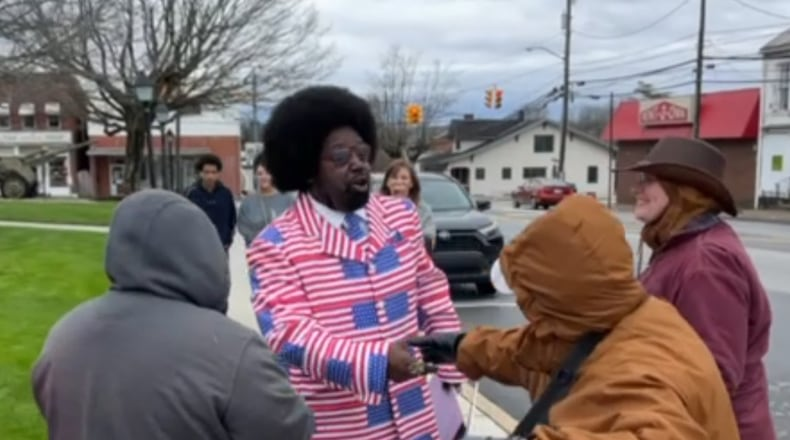
Lemon Pound Cake and the First Amendment: How Afroman Turned a Police Raid Into a Cultural Flashpoint
A Viral Song, a Courtroom Battle, and a Defining Verdict
In a case that blurred the boundaries between music, satire, and constitutional rights, Joseph E. Foreman — better known as Afroman — emerged victorious after a closely watched civil trial in Ohio. At the center of the dispute was his viral track “Lemon Pound Cake”, a song born out of a 2022 police raid that ultimately evolved into a broader commentary on law enforcement, artistic freedom, and public perception.
- A Viral Song, a Courtroom Battle, and a Defining Verdict
- The Origin: A 2022 Raid That Sparked a Cultural Response
- From Evidence to Entertainment: The Birth of “Lemon Pound Cake”
- The Lawsuit: Defamation or Protected Speech?
- The Defense: Satire, Hyperbole, and Artistic Tradition
- The Verdict: A Win for Free Expression
- Public Reaction: Internet Culture Meets Legal Reality
- Cultural and Legal Implications
- What Comes Next?
- Conclusion: When Humor Becomes a Legal Test Case
On March 2026, an Ohio jury ruled in Afroman’s favor, rejecting claims from seven deputies of the Adams County Sheriff’s Office who accused him of defamation, invasion of privacy, and emotional distress. The verdict concluded a three-day trial that raised fundamental questions about where satire ends and harm begins.
Afroman’s immediate response captured the tone of the moment:
“We did it America! Yeah! We did it — freedom of speech! Power to the people!”
The Origin: A 2022 Raid That Sparked a Cultural Response
The events that triggered the controversy date back to August 2022, when deputies executed a search warrant at Afroman’s home in southern Ohio. Officers were reportedly searching for evidence related to drug trafficking and kidnapping.
They found neither.
Instead, what followed was a sequence of events that would later become the foundation for one of the most unusual legal battles in recent entertainment history:

-
Officers broke down the door and searched the property with weapons drawn
-
A family member recorded parts of the raid on a phone
-
Security cameras captured footage of deputies moving through the home
-
Authorities later acknowledged a miscount of cash taken during the search
According to Afroman, the raid left his home damaged and his family shaken. In his words during the trial:
“After they run around my house with guns and kick down my door… I got the right to… use my freedom of speech, turn my bad times into a good time.”
From Evidence to Entertainment: The Birth of “Lemon Pound Cake”
Rather than pursuing a traditional legal or public-relations response, Afroman took a different route — one rooted in his identity as an artist.
He uploaded footage of the raid to social media and began remixing it into music videos. The result was a series of satirical tracks, most notably “Lemon Pound Cake”, named after a moment in the footage where an officer appeared distracted by a cake in his kitchen.



The song’s lyrics encapsulate both humor and critique:
“The Adams County Sheriff kicked down my door / Then I heard the glass break / They found no kidnapping victims / Just some lemon pound cake.”
The music video, released in 2022, has amassed more than 3 million views on YouTube, transforming what might have been a localized incident into a viral cultural phenomenon.
The Lawsuit: Defamation or Protected Speech?
In 2023, seven deputies filed a lawsuit against Afroman, arguing that his videos:
-
Caused “humiliation, ridicule, mental distress, embarrassment and loss of reputation”
-
Included fabricated and damaging claims about their personal and professional lives
-
Crossed the line from satire into defamation
One of the most emotional moments of the trial came when Deputy Lisa Phillips reacted to a video that portrayed her in explicit fictional scenarios. Her distress became a central point for the plaintiffs.
Their attorney, Robert Klingler, framed the issue as one of basic decency:
“A search warrant execution that you think was unfair… doesn’t justify telling intentional lies designed to hurt people.”
The Defense: Satire, Hyperbole, and Artistic Tradition
Afroman’s legal team, led by David Osborne Jr., argued that the content in question was clearly artistic expression — exaggerated, performative, and not meant to be interpreted as factual.
The defense positioned “Lemon Pound Cake” within a broader tradition of provocative music, drawing comparisons to culturally significant works like F**k tha Police and WAP.
Their central argument was straightforward:
-
The deputies, as public figures involved in a public incident, were subject to commentary
-
The lyrics were intentionally exaggerated and comedic
-
No reasonable viewer would interpret the claims as literal fact
Osborne summarized it succinctly:
“That’s all entertainment… it is not fact. And everybody knows that.”
The Verdict: A Win for Free Expression
After deliberation, the jury sided with Afroman, determining that:
-
His use of the footage did not constitute defamation
-
His portrayal of the deputies fell within protected free speech
-
The videos were artistic commentary rather than factual assertions
The ruling reinforced a long-standing legal principle: satire, even when offensive, is generally protected under the First Amendment — particularly when it addresses matters of public interest.
Public Reaction: Internet Culture Meets Legal Reality
Outside the courtroom, the case played out in real time across social media platforms. Afroman’s videos drew both entertainment and political engagement from viewers.
Some comments highlighted the dual nature of the content:
-
“Afroman making the whole second half of his career off that raid”
-
“Watch the videos and laugh… but also pay attention to what’s happening in court”
Supporters framed the case as a broader fight for civil liberties, while critics questioned whether viral humor should come at the expense of individuals’ reputations.
Cultural and Legal Implications
The “Lemon Pound Cake” case sits at the intersection of several critical societal issues:
1. Free Speech vs. Personal Harm
The case underscores the tension between protecting expression and preventing reputational damage. Courts continue to favor speech protections, particularly in artistic contexts.
2. The Power of Digital Platforms
Afroman’s ability to transform raw footage into viral content demonstrates how modern creators can shape narratives outside traditional media channels.
3. Policing and Public Accountability
The incident also raises ongoing questions about law enforcement conduct, transparency, and how such actions are scrutinized in the digital age.
4. The Evolution of Protest Music
By turning a personal experience into a viral track, Afroman effectively revived a long-standing tradition of using music as a tool for critique and resistance.
What Comes Next?
While the legal chapter may be closed, the broader implications are still unfolding:
-
Artists may feel emboldened to push boundaries in satire and commentary
-
Law enforcement agencies could face increased public scrutiny when incidents are captured and shared
-
Courts may continue to refine the limits of digital-era expression
For Afroman, the case marks a notable second act in a career once defined primarily by his 2000 hit Because I Got High. Now, his legacy includes not just chart success, but a precedent-setting legal victory tied to artistic freedom.
Conclusion: When Humor Becomes a Legal Test Case
The “Lemon Pound Cake” saga is more than a viral moment — it is a case study in how modern culture, technology, and law intersect.
What began as a disputed police raid evolved into a courtroom battle with national implications, ultimately reaffirming a core principle: in the United States, satire — even when sharp, uncomfortable, or controversial — remains a protected form of expression.
Afroman’s victory does not resolve the tension between speech and harm, but it does clarify one point: in the age of viral content, the line between personal experience and public commentary is increasingly shaped not just by creators, but by the courts.