





Daniel Radcliffe: From Boy Wizard to Boundary-Breaking Performer
A Career Defined by Transformation
Few actors have experienced a career trajectory as distinctive as Daniel Jacob Radcliffe. Born on July 23, 1989, in Fulham, London, Radcliffe rose to global prominence as the face of one of the most successful film franchises in history—the Harry Potter series—before deliberately reshaping his identity through unconventional roles across film, television, and theatre.
- A Career Defined by Transformation
- The Harry Potter Years: A Global Phenomenon
- The Stunt That Still Stands Out
- A Defining Moment in The Half-Blood Prince
- Life After Hogwarts: Reinvention by Design
- Choosing the Unexpected
- Stage and Television: Expanding the Craft
- From West End to Broadway
- 2026: Reflection, Legacy, and a New Generation
- Watching the Story Begin Again
- Cultural Impact and Enduring Influence
- Beyond a Single Role
- Conclusion: A Career Still Evolving
At 36, Radcliffe’s career is no longer defined solely by the lightning scar he wore for a decade. Instead, it reflects a calculated evolution—one that blends blockbuster legacy with artistic risk-taking, culminating in a Tony Award-winning stage career and a continued presence in contemporary entertainment.
The Harry Potter Years: A Global Phenomenon
Radcliffe’s breakthrough came in 2001 when he was cast as Harry Potter in Harry Potter and the Sorcerer’s Stone. The film’s success launched a decade-long journey that would see him portray the titular character across eight films, concluding in 2011.
The franchise itself became a cultural landmark:
-
Adapted from J.K. Rowling’s novels (1997–2007)
-
Distributed across more than 200 countries
-
Grossed over $7 billion globally
-
Introduced enduring characters such as Ron Weasley and Hermione Granger
Radcliffe, alongside Rupert Grint and Emma Watson, formed the central trio, growing up on screen as the narrative matured from childhood fantasy into darker, more complex storytelling.
Reflecting on that era in March 2026, Radcliffe described the experience with a sense of lasting awe:

“There was so much in those films. It was just crazy to get to do. Honestly, all of the stunt work that I got to do was like mind-blowing.”
The Stunt That Still Stands Out
A Defining Moment in The Half-Blood Prince
Among hundreds of scenes filmed over a decade, one sequence remains etched in Radcliffe’s memory—a technically demanding stunt from Harry Potter and the Half-Blood Prince (2009).
He described the sequence in precise terms:
“There was one shot where I had to start underwater, and then I was on a wire, and they would pull me out of the water, and there was a burning ring of fire around me that it goes to the top and then up.”
The moment culminates in a visually striking image:
“Bursting out of the water through a ring of fire is something that I have not forgotten.”
The sequence illustrates not only the scale of production but also Radcliffe’s direct involvement in physically demanding scenes—an aspect of his performance often overlooked amid the franchise’s visual effects.
Life After Hogwarts: Reinvention by Design
Choosing the Unexpected
Following the conclusion of Harry Potter, Radcliffe avoided the predictable path of franchise-driven stardom. Instead, he pursued roles that challenged both audience expectations and his own range.
His filmography includes:
-
Kill Your Darlings (2013), portraying poet Allen Ginsberg
-
Swiss Army Man (2016), a surreal and unconventional performance
-
Jungle (2017), a survival drama based on real events
-
The Lost City (2022), a mainstream action-comedy
-
Weird: The Al Yankovic Story (2022), a satirical biopic that earned widespread acclaim
This deliberate diversification established Radcliffe as an actor willing to embrace creative risk rather than commercial safety.
Stage and Television: Expanding the Craft
From West End to Broadway
Radcliffe’s commitment to artistic growth is perhaps most evident in his stage work. His performances have spanned both London’s West End and Broadway, including:
-
Equus (2007–2008), a psychologically intense role
-
How to Succeed in Business Without Really Trying (2011)
-
The Cripple of Inishmaan (2014)
-
The Lifespan of a Fact (2018)
His most significant theatrical achievement came in 2024, when he won a Tony Award for Merrily We Roll Along, marking a critical milestone in his transition from film star to respected stage actor.
On television, Radcliffe has also demonstrated versatility, notably in Miracle Workers (2019–2023), where he played a low-level angel in a comedic anthology format.
2026: Reflection, Legacy, and a New Generation
Watching the Story Begin Again
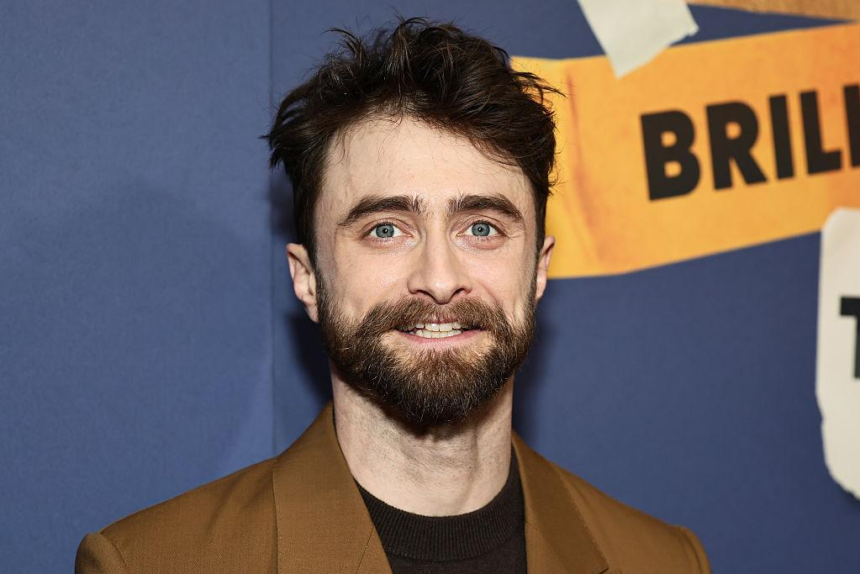
In March 2026, Radcliffe appeared at the premiere of Every Brilliant Thing at the Hudson Theatre in New York City. The production, scheduled for a 13-week Broadway run, represents his continued engagement with live performance.
However, the broader conversation around Radcliffe today extends beyond theatre. With a new Harry Potter television adaptation entering production, he finds himself reflecting on the passage of time and the emergence of a new cast.
The new series introduces:
-
Dominic McLaughlin as Harry Potter
-
Alastair Stout as Ron Weasley
-
Arabella Stanton as Hermione Granger
Radcliffe described the experience of watching a new generation step into those roles as deeply emotional:
“You just see the pictures of these kids, and you just want to grab them and hug them. That’s the impulse that I think that we, mainly, all have.”
He also noted the shared sentiment among the original trio:
“It’s one of those where I think we all just know how the others feel, because we’re also feeling it.”
The comments highlight a rare continuity in modern entertainment—a cast that remains emotionally connected to a franchise long after its conclusion.
Cultural Impact and Enduring Influence
Beyond a Single Role
Radcliffe’s career is often framed through the lens of Harry Potter, but his broader impact lies in how he has navigated life after such a defining role.
Key aspects of his influence include:
-
Demonstrating longevity beyond child stardom
-
Embracing unconventional and experimental storytelling
-
Successfully transitioning between film, television, and theatre
-
Maintaining relevance across generations of audiences
The Harry Potter phenomenon itself reshaped global pop culture, introducing new vocabulary (such as “muggle”), influencing publishing trends, and expanding into theme parks, merchandise, and stage adaptations.
Radcliffe remains central to that legacy—even as he continues to move beyond it.
Conclusion: A Career Still Evolving
Daniel Radcliffe’s journey reflects a rare balance between global fame and artistic independence. From his early days as a child actor in David Copperfield (1999) to his current status as a Tony Award-winning performer, his career demonstrates intentional evolution rather than reinvention by necessity.
His recent reflections—particularly on the physically demanding, “mind-blowing” stunts of his Harry Potter years—offer a glimpse into the lived experience behind one of cinema’s most enduring franchises.
At the same time, his response to the new generation of actors stepping into Hogwarts underscores a broader truth: while roles may be recast, the emotional imprint of storytelling—and those who helped shape it—remains intact.