





SpaceX Rocket Launch Today: How a Predawn Mission Expanded a 10,000-Satellite Network
A Morning Launch With Global Implications
Before sunrise on March 19, 2026, SpaceX returned to the skies over Florida with another tightly scheduled mission from Cape Canaveral. What began as a planned predawn launch window evolved into a later-morning liftoff that still delivered a precise outcome: the successful deployment of 29 additional Starlink satellites into low Earth orbit.
- A Morning Launch With Global Implications
- Launch Timeline: From Window Opening to Liftoff
- The Mission Objective: Expanding Starlink’s Reach
- Reusability in Action: Booster B1077’s 27th Flight
- Weather Constraints and Operational Precision
- A System Operating at Scale
- What This Means for Global Connectivity
- Looking Ahead: The Future of Rapid Launch Cycles
- Conclusion: A Launch That Reflects a New Space Era
The mission—designated Starlink 10-33—represents more than a routine launch. It underscores the accelerating scale of SpaceX’s satellite network and its continued dominance in rapid, reusable rocket operations.
Launch Timeline: From Window Opening to Liftoff
SpaceX initially targeted an early morning launch window that opened at 6:35 a.m. ET and extended until 10:35 a.m. ET. Weather conditions played a role in timing decisions, with forecasts indicating:
-
75% chance of favorable conditions at the start of the window
-
Declining to 60% by the end of the window
-
Potential risks from coastal showers and mid-level cloud layers
Despite these variables, liftoff ultimately occurred at 10:20 a.m. ET (1420 UTC) from Launch Complex 40 at Cape Canaveral Space Force Station.
The Falcon 9 rocket followed a north-easterly trajectory, consistent with prior Starlink Group 10 missions, optimizing orbital insertion for the growing satellite constellation.
The Mission Objective: Expanding Starlink’s Reach
The Starlink 10-33 mission carried 29 Starlink V2 Mini satellites, adding to what is now a constellation exceeding 10,000 spacecraft in orbit.
This milestone reflects a rapid expansion strategy:
-
Continuous deployment cycles throughout 2026
-
Increasing satellite density to improve global coverage
-
Enhanced bandwidth capacity through newer-generation satellites
The deployment sequence occurred just over one hour after liftoff, when the rocket’s upper stage released the satellites into low Earth orbit.
Reusability in Action: Booster B1077’s 27th Flight
A defining feature of this launch was the continued reuse of Falcon 9 hardware.
The mission utilized first-stage booster B1077, marking its:
-
27th flight overall
-
Previous missions including NASA’s Crew-5, CRS-28, and NG-20
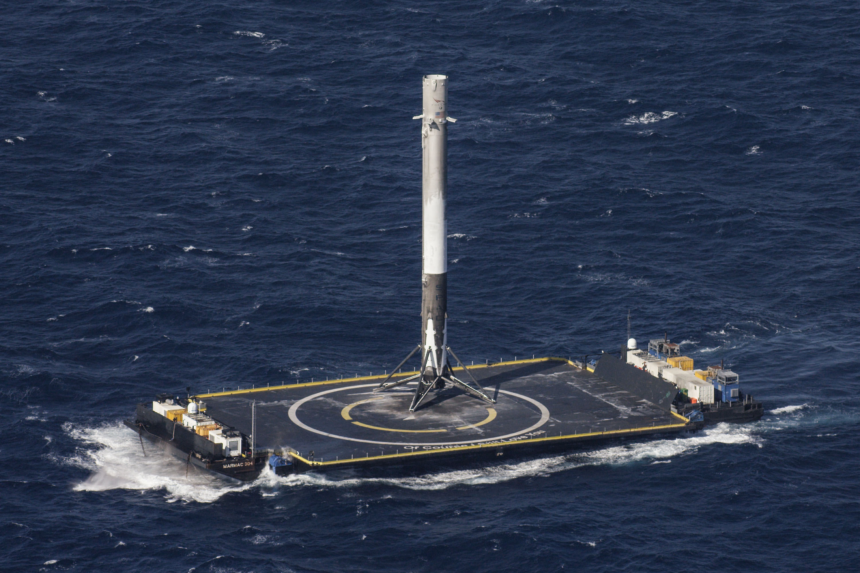
Approximately 8.5 minutes after liftoff, the booster executed a controlled descent and landed successfully on the drone ship “Just Read the Instructions” in the Atlantic Ocean.
This landing marked:
-
The 154th landing on that vessel
-
The 588th booster landing overall for SpaceX
Notably, because the landing occurred offshore, no sonic booms were heard in Brevard County, a detail relevant for local residents.
Weather Constraints and Operational Precision
Launch operations were conducted under a “mixed outlook,” with meteorologists highlighting potential violations of:
-
Cumulus Cloud Rule
-
Thick Cloud Layers rule
These constraints are critical in rocket launches, where atmospheric conditions can affect both ascent safety and visibility. Despite these risks, SpaceX proceeded within acceptable parameters, demonstrating operational flexibility within tight environmental margins.
A System Operating at Scale
The Starlink 10-33 mission was not an isolated event. It followed a series of rapid launches earlier in March, including:
-
A St. Patrick’s Day mission that also deployed 29 satellites
-
Confirmation that SpaceX has now surpassed 10,000 simultaneous Starlink satellites in orbit
This cadence illustrates a broader shift in the space industry:
-
Launch frequency is increasing significantly
-
Reusable rockets are reducing turnaround times
-
Satellite constellations are scaling to unprecedented levels
What This Means for Global Connectivity
At its core, Starlink is designed to provide high-speed internet access worldwide, particularly in underserved or remote regions. Each additional batch of satellites enhances:
-
Coverage consistency
-
Network redundancy
-
Data throughput
With more than 10,000 satellites now active, SpaceX is moving closer to a fully realized global broadband infrastructure, competing directly with terrestrial telecom networks.
Looking Ahead: The Future of Rapid Launch Cycles
The success of today’s launch reinforces several emerging trends:
-
Routine orbital missions are becoming standard rather than exceptional
-
Booster reuse continues to improve cost efficiency and reliability
-
Mega-constellations are reshaping both communications and space traffic management
As SpaceX maintains its aggressive launch schedule, future missions will likely focus on:
-
Upgrading satellite technology
-
Expanding capacity in high-demand regions
-
Integrating Starlink services with commercial and government applications
Conclusion: A Launch That Reflects a New Space Era
The March 19 SpaceX rocket launch was technically routine but strategically significant. It demonstrated the company’s ability to operate at scale, manage environmental constraints, and execute precise missions with reusable hardware.
More importantly, it highlighted how spaceflight has transitioned from rare spectacle to industrial operation—where launches like Starlink 10-33 are not just events, but building blocks of a rapidly expanding orbital infrastructure.
