






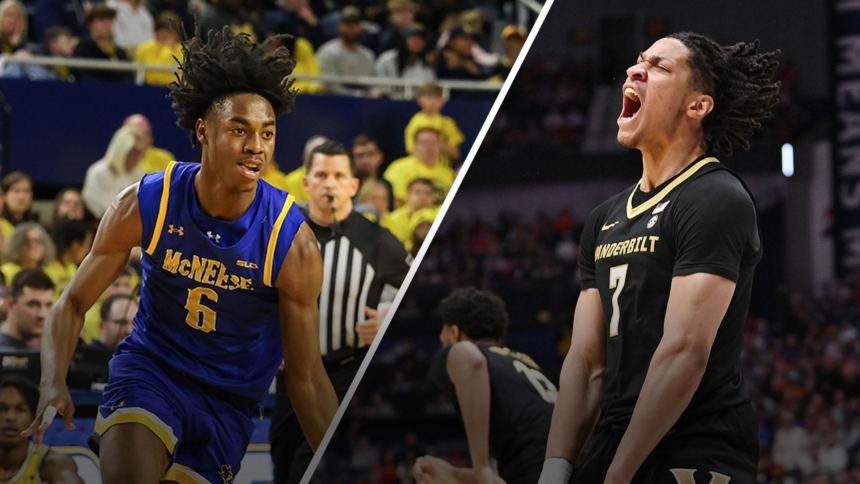
McNeese Basketball: The Anatomy of a March Madness Disruptor
A 12-Seed Built for Chaos
Every March, the NCAA Tournament produces a familiar storyline: the dangerous 12-seed capable of dismantling expectations. In 2026, McNeese basketball fits that profile with precision.
- A 12-Seed Built for Chaos
- The System: Defense First, Pressure Always
- A Proven Giant-Killing Blueprint
- Form and Momentum: A Team Peaking at the Right Time
- The Vanderbilt Challenge: Efficiency vs Disruption
- Structural Weaknesses: Where McNeese Is Vulnerable
- Why This Matchup Matters
- The Bigger Picture: McNeese and the Culture of March Madness
- Conclusion: A Live Underdog With a Defined Identity
Entering their Round of 64 matchup against Vanderbilt, the McNeese Cowboys are once again positioned as underdogs—this time a No. 12 seed and an 11.5-point underdog. Yet history suggests that label may be misleading. The 5-vs-12 matchup is statistically volatile, with at least one 12-seed upsetting a 5-seed in 34 of the last 40 tournaments. More recently, 5-seeds have fallen in two of four matchups in three of the last four tournaments.
McNeese is not just another underdog. It is a program engineered to disrupt.
The System: Defense First, Pressure Always
McNeese’s identity is anchored in defensive intensity and controlled chaos. The Cowboys lead the nation in defensive turnover rate, forcing turnovers on 25 percent of possessions and generating a +7.3 turnover margin.

This is not incidental—it is systemic.
Their approach prioritizes:
-
Aggressive passing lane denial
-
Relentless on-ball pressure
-
Transition exploitation following forced errors
Although McNeese appears to play at a slower pace on paper, the reality is different. Turnovers create instant fast-break opportunities, effectively accelerating the game in moments that matter.
Statistically, the Cowboys rank 16th in adjusted defensive efficiency, reinforcing that their defensive identity is not just stylistic—it is highly effective.
A Proven Giant-Killing Blueprint
McNeese’s credentials as a tournament disruptor are not theoretical. They executed a similar script last year, entering the tournament as a 12-seed and upsetting Clemson in the first round.
That experience matters.
Tournament basketball rewards:
-
Veteran guard play
-
Defensive discipline
-
Emotional composure under pressure
McNeese checks all three boxes. Their roster composition—built around experienced guards—aligns with the historical profile of successful upset teams.
Form and Momentum: A Team Peaking at the Right Time
Momentum is often a decisive factor in March, and McNeese enters the tournament in strong form.
-
10-game winning streak
-
No losses since February 2
-
Final record: 28-5 overall, 19-3 in conference play
This trajectory suggests a team that has stabilized its system and is executing with consistency.
However, predictive models remain skeptical. ESPN Analytics gives Vanderbilt an 81.2% chance of winning, leaving McNeese with just 18.8% probability. The disparity highlights the tension between statistical projections and tournament unpredictability.
The Vanderbilt Challenge: Efficiency vs Disruption
Vanderbilt presents a contrasting profile.
The Commodores are:
-
Ranked 6th in adjusted offensive efficiency
-
Shooting 79% from the free-throw line
-
Structurally stronger in half-court offense
They enter the matchup following an 86-75 loss to Arkansas in the SEC Championship game, finishing the season at 26-8 overall and 11-7 in the SEC.
A critical factor will be Vanderbilt guard Duke Miles, who is expected to manage ball pressure and initiate offense under duress. McNeese’s defensive scheme specifically targets players in this role.
If Vanderbilt maintains composure, its offensive efficiency could neutralize McNeese’s disruption. If not, the game could tilt rapidly.
Structural Weaknesses: Where McNeese Is Vulnerable
Despite its strengths, McNeese is not without limitations:
-
Inefficient three-point shooting
-
Fouling issues that can concede easy points
-
Limited half-court scoring reliability
Interestingly, these weaknesses may not be entirely detrimental in this context. The Cowboys’ offensive approach emphasizes attacking the rim rather than relying on perimeter shooting, reducing exposure to streaky scoring patterns.
In large spreads, this style can be advantageous. By prioritizing high-percentage interior play, McNeese can remain competitive even without elite shooting.
Why This Matchup Matters
This game encapsulates a broader tension in college basketball:
-
Structured efficiency vs disruptive volatility
-
Predictive analytics vs tournament variance
McNeese represents the latter—a team that introduces unpredictability into otherwise stable models.
The phrase “look for chaos” is not rhetorical. It reflects a tactical reality. If McNeese successfully imposes its defensive pressure, the game will likely shift away from Vanderbilt’s preferred structure.
The Bigger Picture: McNeese and the Culture of March Madness
Programs like McNeese are central to the cultural identity of March Madness.
They embody:
-
Competitive parity across programs
-
The importance of tactical identity over brand size
-
The enduring appeal of underdog narratives
Their presence reinforces why the tournament remains compelling: outcomes are not solely determined by rankings or metrics.
Conclusion: A Live Underdog With a Defined Identity
McNeese basketball enters the 2026 NCAA Tournament not as a passive participant, but as a deliberate disruptor.
With elite turnover generation, strong defensive metrics, and recent tournament pedigree, the Cowboys possess a clear pathway to competitiveness—even against a statistically superior opponent.
The probabilities may favor Vanderbilt. The structure may favor Vanderbilt.
But McNeese brings something different: a system designed to fracture structure itself.
And in March, that can be enough.
