






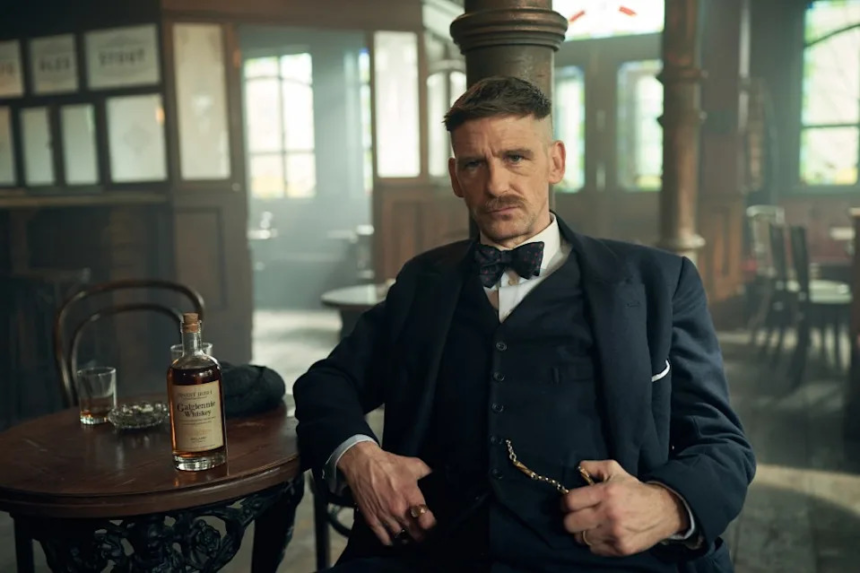
Paul Anderson and the End of Arthur Shelby: A Turning Point for Peaky Blinders
A Defining Shift in a Cult Crime Saga
The absence of Paul Anderson from Peaky Blinders: The Immortal Man marks one of the most consequential creative decisions in the franchise’s history. For a series built on family, loyalty, and volatile personalities, the removal of Arthur Shelby—one of its most unpredictable and emotionally charged characters—signals not just a casting change, but a narrative recalibration.
- A Defining Shift in a Cult Crime Saga
- The Legal Crisis That Reshaped the Film
- A Bold Narrative Decision: Eliminating Arthur Shelby
- The Film in Context: Cast, Timeline, and Absence
- Anderson’s Response: Acceptance Without Bitterness
- Career Recovery and Forward Momentum
- Cultural Impact: What Arthur Shelby’s Exit Means
- A Franchise Rewritten by Reality
- Conclusion: Legacy, Consequences, and Reinvention
What unfolded behind the scenes, however, was not purely artistic. It was shaped by real-world events that forced the production to rethink its direction, ultimately rewriting both character and legacy.
The Legal Crisis That Reshaped the Film
The turning point came in early 2024. Anderson pleaded guilty to possession of class A crack cocaine and class B amphetamines following an incident on December 26, 2023, in London. Authorities reportedly discovered multiple controlled substances, including prescription drugs, during the arrest.
The outcome was swift: a £1,345 fine. But the broader consequences extended far beyond the courtroom.
Within the entertainment industry, the incident triggered immediate concern. For a major production like The Immortal Man, which was already in development, the question was unavoidable—could Anderson remain part of the project?
The answer, ultimately, was no.
A Bold Narrative Decision: Eliminating Arthur Shelby
Rather than recasting Arthur Shelby, the creative team chose a more definitive solution: removing the character entirely from the story.
In Peaky Blinders: The Immortal Man, Arthur is revealed to have died before the film’s events. The opening sequence sets a somber tone, with Cillian Murphy’s Tommy Shelby visiting his brother’s grave, marked with the inscription “in the bleak midwinter.”
The narrative initially frames Arthur’s death as accidental. However, the film delivers a stark twist—Tommy confesses responsibility.
“I killed my own brother, because I wanted to be free of him,”
This revelation reframes not only Arthur’s fate but also Tommy’s psychological trajectory. It deepens the film’s exploration of power, guilt, and liberation, while closing a chapter that had defined the series for nearly a decade.

The Film in Context: Cast, Timeline, and Absence
Released on March 6, 2026, on Netflix, The Immortal Man functions as an epilogue to the original series.
Key details include:
- Lead Performance: Cillian Murphy returns as Tommy Shelby
- New Additions: Barry Keoghan, Rebecca Ferguson, Tim Roth
- Notable Absence: Paul Anderson as Arthur Shelby
The absence is particularly striking given Arthur’s central role throughout the show’s six-season run from 2013 to 2022. His volatile energy, moral ambiguity, and deep bond with Tommy were core elements of the series’ identity.
Anderson’s Response: Acceptance Without Bitterness
Publicly, Anderson has taken a measured and notably restrained stance on his exclusion.
“Well, what can you do eh? It is how it is.”
In interviews, he has expressed “nothing but love and respect for the Peaky Blinders family,” maintaining positive relations with creator Steven Knight.
This response suggests a pragmatic acceptance of circumstances, rather than public dispute—an approach that may influence how the industry continues to engage with him.
Career Recovery and Forward Momentum
Despite the setback, Anderson’s career is not static. He is reportedly focusing on new projects, including The Gray House, which is currently performing strongly on Amazon Prime Video.
Industry observers note that rehabilitation—both personal and professional—is a familiar arc in entertainment. Anderson’s willingness to move forward, coupled with ongoing work, positions him for a potential return to prominence.
The coming year, particularly 2026, will likely determine whether this episode becomes a temporary disruption or a defining turning point.
Cultural Impact: What Arthur Shelby’s Exit Means
Arthur Shelby’s removal is not merely a plot adjustment—it alters the emotional architecture of Peaky Blinders.
For audiences, Arthur represented chaos, loyalty, and vulnerability in equal measure. His absence leaves a void that reshapes how viewers interpret Tommy’s journey. The film, now framed as a solitary reckoning, leans more heavily into themes of isolation and internal conflict.
From a broader industry perspective, the situation highlights a recurring dynamic: the intersection of personal conduct and professional opportunity. Productions increasingly weigh reputational risk alongside creative considerations, particularly in high-profile franchises.
A Franchise Rewritten by Reality
The Immortal Man stands as a rare example of a narrative directly reshaped by off-screen events. The decision to write out Arthur Shelby was not simply a workaround—it became a defining creative choice that influenced the film’s tone, structure, and thematic depth.
For Peaky Blinders, it closes an era.
For Paul Anderson, it opens an uncertain but active new chapter.
Conclusion: Legacy, Consequences, and Reinvention
The story of Paul Anderson and Arthur Shelby is ultimately one of convergence—where real-life consequences intersect with fictional storytelling. The result is a film that carries both narrative weight and cultural context.
Arthur Shelby’s death may mark the end of one of television’s most memorable characters, but it also underscores a broader reality: in modern entertainment, the boundary between personal actions and professional outcomes is increasingly thin.
What follows—for both the actor and the franchise—will determine how this moment is remembered: as a rupture, or as a pivot toward reinvention.