





Kaia Gerber and the Revival of a Supermodel Legacy
A cultural and fashion analysis
- Introduction: A Familiar Face, Reimagined for a New Era
- The Oscars After-Party Moment That Sparked Conversation
- Fashion as Inheritance: More Than Just Resemblance
- The Power of the Red Dress: Symbolism and Continuity
- Public Reception: Familiarity as Appeal
- Hollywood’s Obsession with Lineage
- Strategic Styling and Brand Positioning
- Looking Ahead: Evolution or Reinvention?
- Conclusion: A Legacy Reframed for the Present
Introduction: A Familiar Face, Reimagined for a New Era
In an industry that constantly reinvents itself, few narratives are as compelling as legacy—particularly when it arrives with unmistakable visual continuity. Kaia Gerber’s recent appearance at the Vanity Fair Oscars after-party on March 15, 2026, did more than turn heads. It reignited a conversation about heritage, identity, and the cyclical nature of fashion.
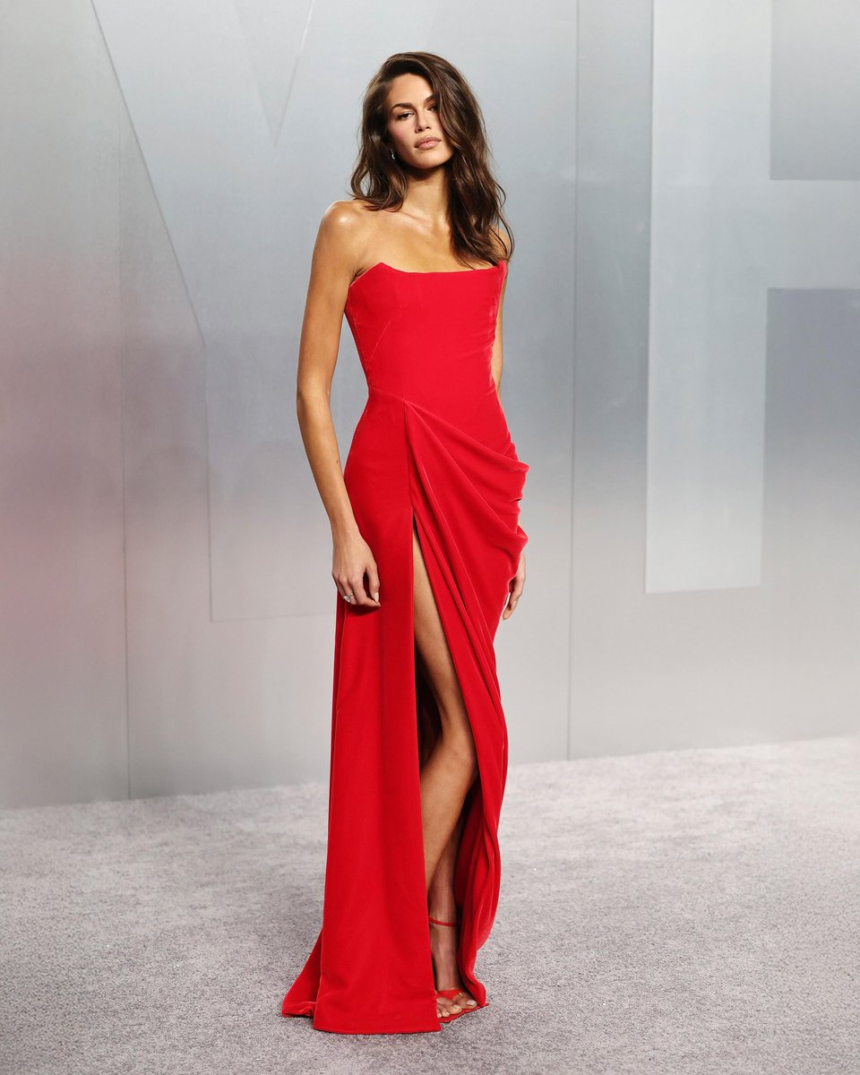
Dressed in a red velvet strapless gown with a dramatic thigh-high slit, Gerber was widely described as “the spitting image of a young Crawford.” The resemblance was not incidental. It was deliberate, curated, and culturally resonant.
The Oscars After-Party Moment That Sparked Conversation
At one of Hollywood’s most closely watched post-award events, Gerber’s styling choices became the focal point of the evening. She wore a custom Givenchy gown by Sarah Burton—structured, strapless, and finished with an elegant train. The velvet texture and bold crimson tone reinforced the visual callback to classic supermodel aesthetics.
Her beauty styling completed the narrative. With a deep side part and voluminous, undone waves, paired with bronzed makeup by artist Jamal Scott, Gerber’s look mirrored a signature aesthetic long associated with Cindy Crawford in the 1990s.
Observers noted the precision of the homage. Crawford herself had worn a nearly identical combination—side-swept hair and a red dress—over 30 years earlier, including a memorable 1995 appearance that remains part of fashion’s visual archive.



Fashion as Inheritance: More Than Just Resemblance
Kaia Gerber’s red carpet presence is frequently framed through comparison. However, this framing underestimates the strategic dimension of her image-building.
The recurrence of “mini-me” narratives reflects more than genetics. It points to a calculated alignment with one of fashion’s most recognizable archetypes: the 1990s supermodel. By channeling Crawford’s visual language—red dresses, minimal yet sculptural silhouettes, and natural glamour—Gerber positions herself within a lineage that carries both cultural authority and commercial appeal.
This was not her first such moment.
-
In October, she referenced Crawford’s iconic Versace campaign from the 1990s.
-
In November, she appeared in another red shift dress reminiscent of Crawford’s signature looks.
-
In 2024, she recreated the white slip dress worn by Crawford at the 1993 Oscars.
These moments collectively form a pattern: a sustained engagement with archival fashion as a living narrative.
The Power of the Red Dress: Symbolism and Continuity
The red dress—often referred to as the “LRD” (Little Red Dress)—has long been associated with Cindy Crawford’s image. Its recurrence in Gerber’s wardrobe is not coincidental.
Historically, Crawford wore multiple variations of the crimson silhouette throughout her career, making it a defining visual motif. By adopting this element, Gerber taps into a symbolic shorthand that communicates confidence, sensuality, and timeless glamour.
At the Oscars after-party, the effect was amplified by construction details:
-
A corset-style bodice emphasizing structure
-
A thigh-high slit introducing movement and modernity
-
Velvet fabric adding depth and richness under lighting
The result was a hybrid aesthetic—simultaneously archival and contemporary.
Public Reception: Familiarity as Appeal
Audience response to Gerber’s appearance was immediate and largely positive. Social media commentary emphasized descriptors such as “Gorgeous” and “Beautiful,” reinforcing the effectiveness of the visual strategy.
This reception highlights a broader trend: audiences are drawn to recognizable aesthetics, particularly when they are reinterpreted rather than replicated. Gerber’s look did not merely imitate Crawford; it updated the reference for a modern red carpet context.
Her posing further reinforced the garment’s design. Angled stances highlighted the dress’s fitted structure and slit, while side profiles emphasized the draped fabric and extended train. These choices demonstrate an understanding of how fashion operates in a media-driven environment where imagery is primary.
Hollywood’s Obsession with Lineage
Gerber’s moment sits within a wider cultural pattern: Hollywood’s fascination with generational continuity. The concept of “mini-mes” extends beyond fashion into film, music, and celebrity culture.
However, Gerber’s case is particularly pronounced due to the visual symmetry between her and Crawford. Unlike many second-generation celebrities who differentiate themselves sharply, Gerber leans into resemblance as a defining feature of her public identity.
This approach offers several advantages:
-
Immediate recognition in a saturated industry
-
Built-in narrative continuity
-
Strong alignment with established fashion history
At the same time, it raises questions about individuality and long-term positioning—issues that will likely shape her evolving career.
Strategic Styling and Brand Positioning
From a market perspective, Gerber’s appearance illustrates how styling functions as brand architecture.
Key stakeholders in this process include:
-
Designers (Givenchy, under Sarah Burton)
-
Beauty professionals (Jamal Scott)
-
Event platforms (Vanity Fair Oscars after-party)
Each contributes to a coordinated output that reinforces Gerber’s positioning as both a contemporary model and a custodian of a legacy aesthetic.
This alignment is particularly valuable in luxury fashion, where heritage remains a central selling point. By embodying a recognizable lineage, Gerber becomes a bridge between past and present—an asset for brands seeking continuity alongside innovation.
Looking Ahead: Evolution or Reinvention?
The central question following this appearance is whether Gerber will continue to anchor her identity in homage or gradually pivot toward a more distinct visual language.
Current evidence suggests a dual-track approach:
-
Continued references to Crawford-era aesthetics
-
Incremental integration of modern silhouettes and styling
This hybrid strategy allows her to maintain the advantages of recognition while expanding her own creative range.
Conclusion: A Legacy Reframed for the Present
Kaia Gerber’s Oscars after-party appearance was not simply a fashion highlight. It was a carefully constructed moment that blended nostalgia, branding, and cultural resonance.
By revisiting and reinterpreting Cindy Crawford’s iconic visual codes, Gerber demonstrates how legacy can function as both foundation and strategy. The result is a presence that feels simultaneously familiar and current—an increasingly rare balance in contemporary celebrity culture.
Whether she ultimately defines herself beyond this lineage remains to be seen. For now, her ability to channel—and modernize—one of fashion’s most enduring images continues to command attention.