




Banksy: The Mystery That Refuses to Fade — Even as New Clues Emerge
The Identity Question Returns to the Spotlight
For more than three decades, the name Banksy has carried a paradox: global recognition without personal visibility. The anonymous street artist has built one of the most influential modern art careers while deliberately erasing his own identity from public view.
- The Identity Question Returns to the Spotlight
- A Career Built on Anonymity
- The Reuters Investigation: What It Claims
- The Response: Denial Without Disclosure
- A Timeline of Theories and Misidentifications
- The Art That Overshadows the Artist
- Why the Mystery Still Matters
- The Paradox: Known Everywhere, Seen Nowhere
- Conclusion: Mystery as Method
That balance is now under renewed pressure.
A recent investigation by Reuters has reignited one of the art world’s longest-running mysteries, claiming “beyond dispute” that Banksy is a British man named Robin Gunningham, a theory that has circulated for years but has never been officially confirmed. The report draws on court documents, arrest records, and historical clues—yet, despite the depth of evidence, the question remains unresolved.
The result is a familiar tension: the closer the world seems to getting an answer, the more elusive Banksy becomes.

A Career Built on Anonymity
Banksy emerged from the Bristol underground art scene in the 1990s, developing a distinctive stencil-based style that allowed for speed, anonymity, and sharp political messaging.
His work is immediately recognizable:
-
Minimalist, high-contrast stencil imagery
-
Dark humor combined with social critique
-
Placement in public, often unauthorized spaces
Over time, his art moved beyond local walls in England to become a global visual language, appearing across cities, conflict zones, and politically sensitive locations—including Ukraine and the Palestinian West Bank.
Banksy has described inspiration from graffiti artist 3D of Massive Attack, linking his work to a broader cultural movement rooted in music, activism, and street expression.
The Reuters Investigation: What It Claims
The latest surge in speculation stems from a detailed Reuters investigation that attempts to connect decades of clues into a single conclusion.
Key findings highlighted in the report:
-
A 2000 arrest in New York during Fashion Week tied to vandalizing a Marc Jacobs billboard
-
A handwritten confession linked to the incident
-
Court documents referencing the name Robin Gunningham
-
Evidence suggesting the individual later changed his name to David Jones in 2008
The New York incident itself has become part of Banksy folklore. According to photographer Steve Lazarides, the artist climbed onto a rooftop and altered a billboard so that the model had “goofy teeth.” He was charged with a misdemeanor and fined USD 310.
Reuters journalists argue that the combination of legal records, historical timelines, and travel patterns forms a consistent identity trail.
However, crucially, there is still no official confirmation.
The Response: Denial Without Disclosure
Banksy’s legal representative, Mark Stephens, responded cautiously to the claims, stating:
“Banksy does not accept that many of the details contained within your enquiry are correct.”
He also emphasized why anonymity remains essential:
“[Working] anonymously or under a pseudonym serves vital societal interests. It protects freedom of expression by allowing creators to speak truth to power without fear of retaliation, censorship or persecution—particularly when addressing sensitive issues such as politics, religion or social justice.”
This response does not directly deny the claims—but it reinforces the principle that the identity itself is secondary to the work.
Former manager Steve Lazarides added further ambiguity, suggesting there was no “Robin Gunningham” in the way the media portrays, while also noting the artist changed his name around 2008.
The pattern is consistent: partial acknowledgment, but never confirmation.
A Timeline of Theories and Misidentifications
The Banksy identity debate has produced a long list of theories—some credible, others clearly speculative.
Notable claims over the years:
-
2003: Journalist Simon Hattenstone described Banksy as “white, 28, scruffy casual,” offering one of the earliest personal sketches
-
2008: Reports linked him to Robin Gunningham, born July 28, 1974, in Yate
-
2017: DJ Goldie referred to Banksy as “Rob”
-
2023: Banksy himself suggested his forename is “Robbie”
Other theories have ranged widely:
-
Robert Del Naja (Massive Attack)
-
Thierry Guetta (Mr Brainwash)
-
Viral hoaxes involving unrelated individuals
Each theory adds another layer, but none have definitively resolved the mystery.
The Art That Overshadows the Artist
While speculation continues, Banksy’s work remains the central force behind his global relevance.
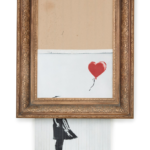
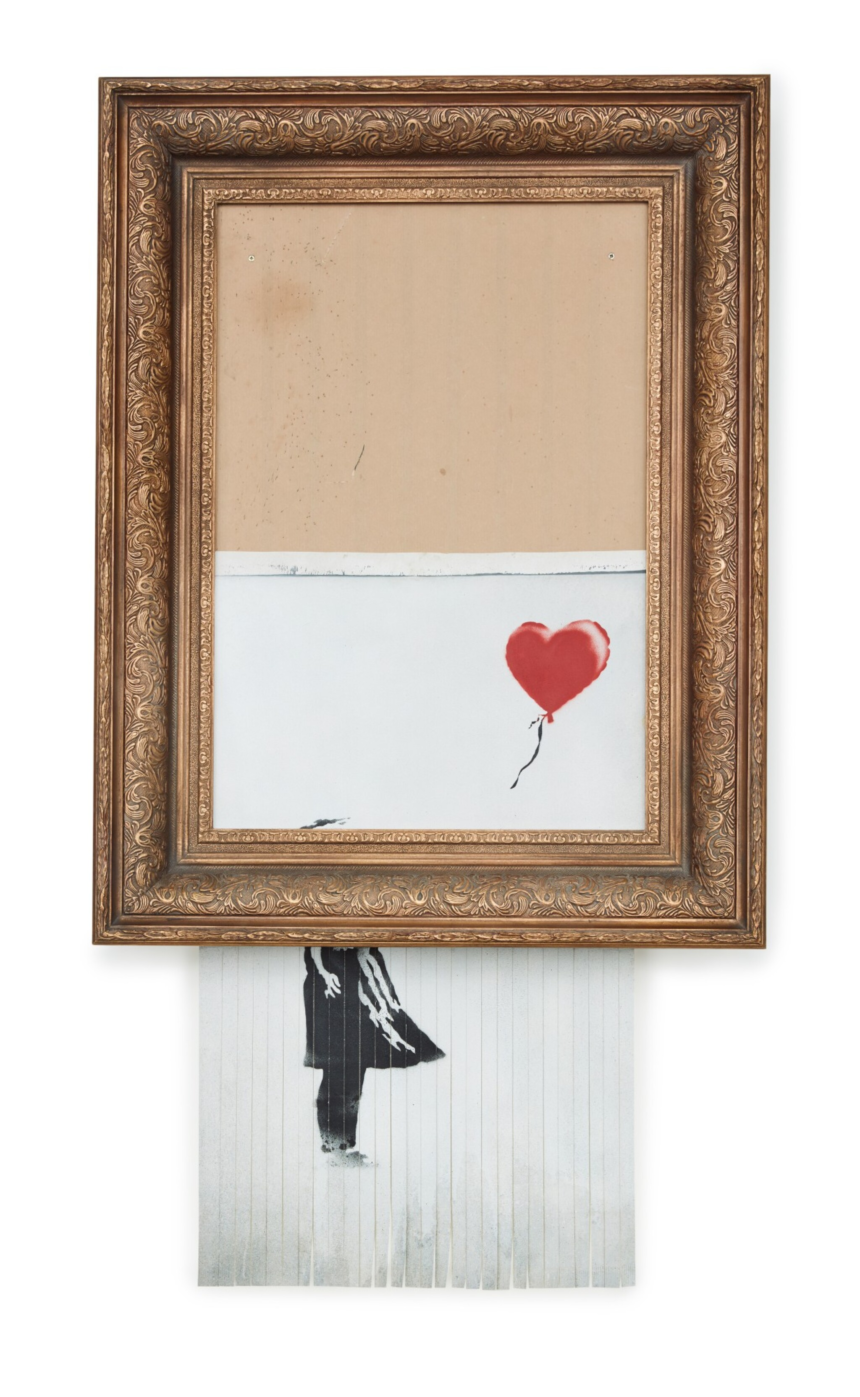
“Girl with Balloon” → “Love is in the Bin”
Perhaps the most famous moment in contemporary art history:
-
Originally sold for USD 1.4 million
-
Immediately self-shredded via a hidden device in the frame
-
Renamed Love is in the Bin
-
Later resold for over USD 25 million
This act redefined the relationship between art, performance, and value—turning destruction into creation.
Other recurring themes in his work:
-
Anti-war messaging
-
Surveillance and state power
-
Consumerism critique
-
Social justice advocacy
Recent works have included imagery such as a judge striking a protester, reinforcing his ongoing engagement with political systems.
Why the Mystery Still Matters
The persistence of Banksy’s anonymity is not accidental—it is structural to his influence.
Key reasons the identity remains significant:
-
Legal Protection
Graffiti is often illegal. Anonymity shields the artist from prosecution. -
Artistic Integrity
The focus remains on the message, not the personality. -
Cultural Mythology
The mystery itself enhances public fascination and market value. -
Freedom of Expression
As his lawyer stated, anonymity allows commentary without retaliation.
In effect, Banksy’s identity is both a liability and an asset—something to be protected, yet constantly pursued.
The Paradox: Known Everywhere, Seen Nowhere
Banksy represents a rare phenomenon in modern culture: a globally dominant figure whose physical identity is irrelevant to his success.
Even if the Reuters claims prove accurate, the broader question remains:
Would revealing Banksy change anything essential about his work?
History suggests it would not.
The power of Banksy lies in the art’s ability to appear unexpectedly, provoke instantly, and disappear without explanation. The anonymity is not a gap—it is part of the design.
Conclusion: Mystery as Method
The renewed speculation around Banksy’s identity demonstrates how deeply the artist has embedded himself into both cultural and media narratives.
Each new investigation promises resolution. Each response maintains ambiguity.
For now, the situation remains unchanged:
-
A name has been proposed
-
Evidence has been presented
-
Denials have been issued
-
Confirmation has not arrived
And Banksy, as always, remains visible everywhere—except where it matters most.